

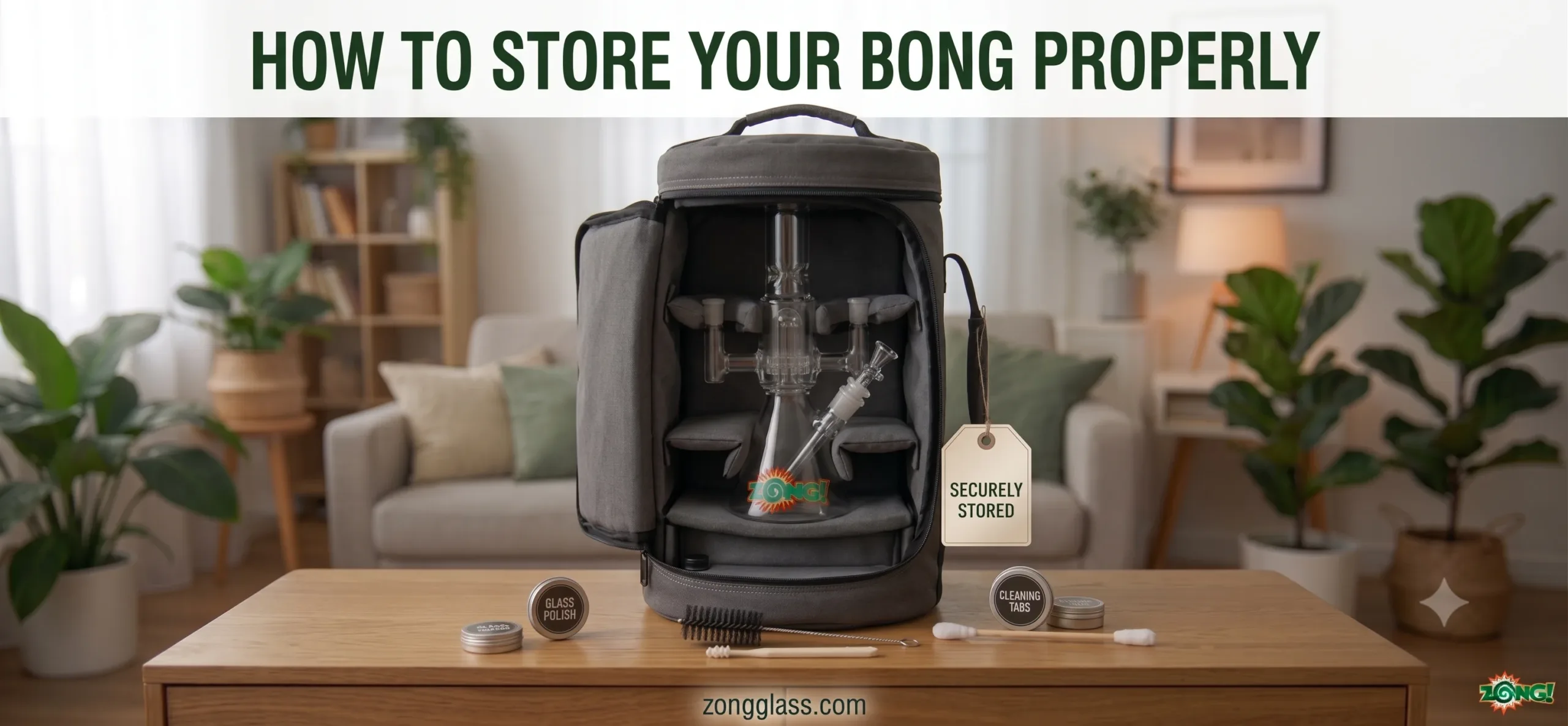
How to Store Your Bong Properly — The Habits That Keep Your Glass Safe
Most bong breakage doesn’t happen during a session. It happens between them.
A piece left in the wrong spot, a careless storage habit, a flat surface that’s slightly less stable than it looked — these are the moments that end a piece’s life. And almost all of them are completely preventable.
Here’s the honest guide to storing your bong properly — from what to do immediately after a session to how to think about long-term care for serious investment pieces.
Why Storage Matters More Than You Think
When you’re actively using your bong, you’re paying attention to it. You’re handling it carefully, keeping it stable, passing it deliberately. The risk window is actually smaller than most people assume.
The risk window opens the moment you put the piece down after a session — and stays open until the next one. An unsecured piece on a table edge, a dog that knocks things over, a housemate who doesn’t know the piece is there, a slightly uneven surface — any of these can send a piece to the floor while nobody’s looking.
Good storage habits close this risk window completely. Once a piece is in its designated spot, stored correctly, it stays safe.
Step 1 — Empty the Water Immediately After Every Session
This is the most important storage habit and the one most smokers skip.
Old bong water sitting in a piece overnight — or longer — does three things, all of them bad:
It accelerates residue buildup. Dissolved tar and resin compounds in the water deposit on the glass walls as the water sits. The longer it sits, the more layers of residue adhere to the chamber, neck, and kinks.
It creates mould conditions. Warm, organic-matter-rich water at room temperature is exactly what mould needs. Visible growth can start within days. Bacterial growth begins much sooner.
In cold environments, it can freeze and crack glass. Water expands when it freezes. A piece left with water in a cold room, car, or outdoor space overnight risks cracking from the expansion pressure — even quality borosilicate glass.
Empty the water, give the piece a quick warm rinse, and store dry. This takes 30 seconds and prevents every one of these problems.
Step 2 — Disassemble Before Storing
Bowl in. Downstem in. Piece on the shelf. This is the default for most smokers — and it’s the second most common cause of breakage after unstable placement.
Leaving the bowl and downstem inserted during storage creates two risks:
Any bump to the piece now involves the bowl and downstem. A knock that moves the piece a few centimetres is enough to clip the bowl against something, snap the downstem at the joint, or chip the joint opening itself.
The inserted accessories concentrate stress at the joint. Glass-on-glass joints are precision-ground to create an airtight seal. Continuous stress from an inserted downstem — especially if the piece gets knocked — wears the joint over time and can create micro-cracks that aren’t visible until the joint fails.
Remove the bowl and downstem before storing. Keep them in a zip-lock bag, a small padded pouch, or a dedicated accessories container. This takes 10 seconds and eliminates both risks.
Keep replacement downstems and replacement bowls on hand so a chipped accessory doesn’t interrupt your setup.
Step 3 — Choose a Dedicated, Consistent Spot
A dedicated spot for your piece is the single most effective storage decision you can make — more important than any accessory or case.
The criteria for a good storage spot:
Away from edges. Table edges, counter edges, shelf edges — anything where a small nudge sends the piece over the side. Your storage spot should have solid surface on all sides, not proximity to a drop.
Away from high-traffic paths. Don’t store your piece where people walk, where pets move, or where doors swing open. The piece doesn’t need to be in a difficult location — just away from movement.
Stable, flat surface. Even a 2-degree tilt on a surface can create a slow lean on a tall piece. Test your surface by setting the piece down and watching it for a moment — it should sit completely still without any tendency to slide or tilt.
Consistent. The most important variable isn’t where you choose — it’s that you use the same spot every time. A consistent spot becomes muscle memory. You always know where your piece is. You never search for it by moving it through risky positions. And anyone else in your household knows not to place things there.
For larger pieces — the Monster Zong® 75mm, the 9mm Thick Zong®, the Full Gold 6 Kink Zong® — a dedicated shelf or display area is worth setting up. These are pieces built to last decades; a properly considered display spot is part of owning them well.
Step 4 — Add a Silicone Mat Under the Piece
One of the lowest-cost, highest-impact storage additions: a silicone mat under your piece’s storage spot.
Silicone mats add friction between the glass base and the surface — meaning nudges that would slide a piece toward an edge on a smooth surface are absorbed instead. They also provide a small amount of impact cushioning, which doesn’t prevent catastrophic drops but meaningfully reduces the consequences of minor bumps and vibrations.
For beaker-based Zong® pieces — the Fat Series 50mm, the Worked Full Color 2 Kink Zong®, the beaker configuration of the Full Gold 2 Kink Zong® — the wide base already provides excellent natural stability. A silicone mat underneath takes that stability further.
Step 5 — Consider Padded Storage for Investment Pieces
For collector-level pieces — the Full Gold 6 Kink Zong®, the Worked Color 9mm Zong®, the Monster Zong® 75mm — a padded hard case is worth the investment.
Hard cases with foam inserts protect against impacts that a shelf position can’t. For pieces that travel (even short distances — to a friend’s place, between rooms during a move), a hard case is the difference between arriving intact and arriving in pieces.
When measuring for a case, remember that Zong® pieces are taller than their tube height suggests — the Z-neck extends the piece’s vertical dimension above the base. Measure the full piece from base to mouthpiece tip before purchasing a case.
Storing Accessories
Bowl, downstem, and ash catcher storage is as important as the main piece.
Bowl and downstem: A small padded pouch or zip-lock bag keeps them protected, together, and easy to find. The zip-lock bag doubles as your cleaning vessel — drop them in with isopropyl alcohol and coarse salt, seal, shake, rinse. No separate container needed.
Z-Catcher ash catcher: Store it disassembled alongside the bowl and downstem. The ash catcher is a glass piece in its own right — it deserves the same care, not to be left attached to the main piece and bumped around during storage.
Grunge Off Super Soaker: Keep it accessible near your storage spot. If the cleaning kit requires a separate trip to find, cleaning happens less consistently. Accessibility is part of the routine.
The Complete Storage Routine
| Timing | Action |
|---|---|
| After every session | Empty water, quick warm rinse, remove bowl and downstem |
| Before storing | Piece empty and dry, accessories in pouch or bag |
| Storage spot | Dedicated, flat, stable, away from edges and traffic |
| Under the piece | Silicone mat for grip and minor cushioning |
| Accessories | Stored in padded pouch or zip-lock alongside the piece |
| Weekly | Full Grunge Off clean before the next session |
Shop Zong® pieces and accessories: Full Color 1 Kink Zong® | Fat Series 50mm | 9mm Thick Zong® | Full Gold 6 Kink Zong® | Monster Zong® 75mm | Z-Catcher Ash Catcher | Grunge Off Glass Cleaner | Replacement Bowls | Replacement Downstems | Browse all Zong® pieces