

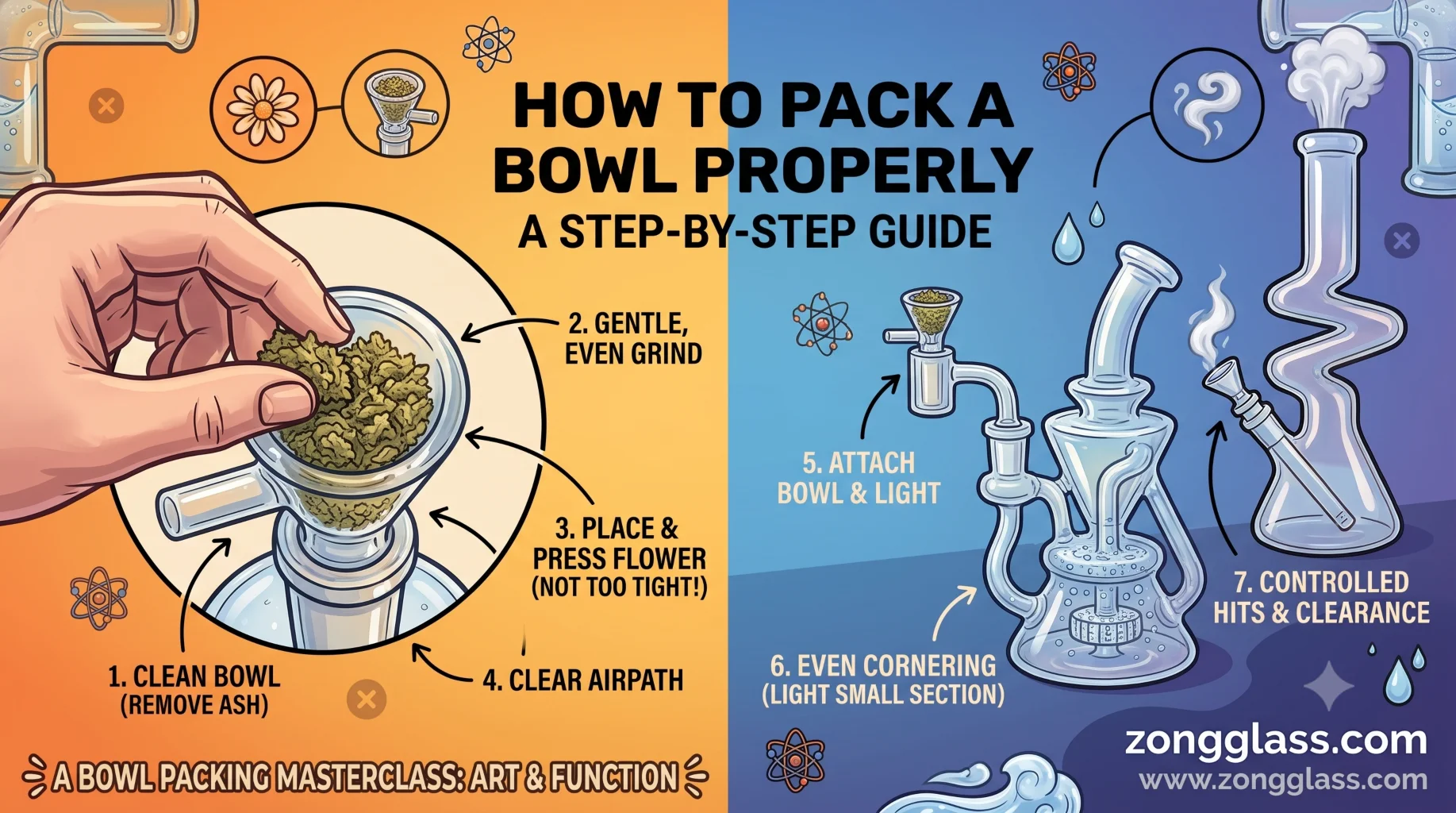
How to Pack a Bowl the Right Way — Better Airflow, Better Hits
Most smokers never think twice about how they pack a bowl. Grind it, stuff it, light it. But how you pack your bowl has a direct and measurable effect on every single hit — airflow, burn consistency, how long it lasts, and how smooth the smoke is by the time it reaches your lungs.
Getting it right takes about 30 seconds of extra attention. Here’s exactly how.
Why Packing Technique Actually Matters
A bowl is essentially a small combustion chamber. For it to work properly, air needs to flow through it consistently — from the bottom of the bowl, through the material, past the flame, and down the downstem into the water.
Pack too loosely and the material falls through the downstem, restricts airflow inconsistently, and burns unevenly. Pack too tightly and you’re fighting restricted airflow the entire hit — more lung effort, less smoke, more frustration.
The right pack creates a structure that holds material above the bowl hole, allows consistent airflow through the material, burns evenly from the surface down, and leaves no debris falling into the water chamber.
Your bowl quality also plays a role here. A properly designed bowl — like those in the Zong Glass® bowls range — has an opening geometry that works with good packing technique rather than against it. Poorly shaped budget bowls create airflow problems that no amount of technique fully fixes.
Step 1 — Grind Consistently
The grind is the foundation of everything. Material that isn’t ground produces uneven packs, inconsistent burns, and restricted airflow.
A medium-coarse grind is the target. Fine enough that material doesn’t clump or restrict airflow; coarse enough that it doesn’t fall straight through the bowl hole or pack so densely that air can’t move.
What to avoid:
- Too fine: Packs too densely, restricts airflow significantly, material may pull through into the downstem
- Too coarse: Burns unevenly, harsh hits, material falls through before it combusts
- Unground: Worst of all options — inconsistent airflow, hot spots, material that burns on the outside while staying unburned in the centre
If you don’t have a grinder, breaking material by hand produces a reasonable coarse grind that works better than nothing. But a quality grinder consistently produces better results than hand-breaking, and the difference is noticeable in every session.
Step 2 — Use a Screen or a Coarse Base Layer
Before packing the main bowl, place a small piece of glass screen in the bottom — or a few small stems or a piece of coarser material — to prevent fine ground herb from pulling straight through the bowl hole into the downstem.
This single step eliminates one of the most common issues in poorly packed bowls: the fine debris that ends up in your water, in your downstem, and eventually accumulated in your piece. It also protects your downstem from accumulating resin-coated debris at the bottom, which clogs airflow over time and accelerates the frequency of deep cleans.
Adding a Z-Catcher ash catcher to your setup handles this problem upstream — catching debris before it ever reaches the main chamber — making it the most practical accessory for anyone who wants to protect their piece and reduce cleaning frequency simultaneously.
Step 3 — Pack in Layers, Not All at Once
The most common packing mistake is dumping a full amount of ground material into the bowl and pressing it down in one motion. This creates a uniformly dense pack that restricts airflow from bottom to top.
Instead, pack in two or three light layers:
Layer 1 — Loose base: Drop a small pinch of ground material into the bowl. Leave it loose — don’t press. This layer sits above the bowl hole and allows initial airflow.
Layer 2 — Middle layer: Add the main amount of material. Use a finger or the flat end of a tool to press it gently — not firmly. You’re creating enough structure to hold the material in place during the hit, not compressing it into a solid block.
Layer 3 — Top layer (optional): For a larger bowl, a final light top layer that’s left completely unpressed gives the flame a clean surface to catch on without creating a sealed top that smothers airflow.
The test: after packing, you should be able to draw air through the bowl with your mouth over the top (unlit) and feel consistent, easy airflow. If it feels like breathing through a clogged straw, it’s too tight. If material visibly shifts with a light draw, it’s too loose.
Step 4 — Light It Right
Lighter technique affects how evenly and efficiently your packed bowl burns.
Corner lighting: Rather than applying the flame directly to the centre of the bowl surface, touch the flame to one edge or corner of the packed material. Draw as you light. This ignites a section of the surface rather than the whole top at once, leaving unlit material for subsequent hits from the same bowl — more efficient, better flavour on each pull.
Don’t hold the flame in the bowl: Lighter fluid combustion produces its own compounds that affect flavour. Touch the flame briefly to ignite, then pull away and let the cherry sustain itself. The material should continue to burn with a draw once it’s caught — you don’t need continuous flame.
Clearing the bowl: Once the surface material is spent (grey ash), use a poker or small tool to gently stir the bowl before re-lighting. This brings unburned material from beneath the surface to the top and extends the bowl’s life without repacking.
Step 5 — Match Your Bowl Size to the Session
Bowl size is a setup decision that most smokers make once and then forget — but it’s worth thinking about deliberately.
A smaller bowl produces a shorter session per pack — appropriate for solo use where efficiency and freshness matter. A larger bowl is designed for group sessions where the piece is being passed and each person needs a genuine hit.
The Zong Glass® bowls range includes options across this spectrum. All are 14mm glass-on-glass, fitting the standard joint on every Zong® waterpipe — from the Full Color 1 Kink Zong® and Fat Series 50mm through to the Monster Zong® 75mm and the 9mm Thick Zong®.
If you’re running a Zubbler — Nano, Micro, 45mm, or 50mm — the same 14mm bowl standard applies. The Zubbler’s inline perc means even a well-packed bowl delivers an exceptionally smooth pull through the water filtration stage.
Maintaining Your Bowl
A well-packed bowl produces more resin accumulation per session than a poorly packed one — because more material is combusting consistently. This means your bowl needs regular cleaning to maintain airflow quality.
Soak the bowl in a zip-lock bag with isopropyl alcohol and coarse salt, or drop it in Grunge Off Super Soaker for 15–20 minutes. Rinse thoroughly. A clean bowl produces noticeably better airflow and flavour than a residue-coated one — and the difference is immediate the session after you clean it.
Replace your bowl if you notice: chips or cracks near the joint, a loose fit in the downstem joint, or airflow restriction that cleaning doesn’t resolve. Zong Glass® replacement bowls are sized correctly for the Zong® joint and built from the same Schott borosilicate glass as the rest of the lineup.
The Quick Reference
| Too Loose | Too Tight | Just Right | |
|---|---|---|---|
| Airflow | Inconsistent | Restricted | Smooth and easy |
| Burn | Uneven | Slow, harsh | Even and consistent |
| Debris | Falls through | Stays but clogs | Held by base layer |
| Hit quality | Variable | Laboured | Clean and smooth |
Shop bowls and accessories: Replacement Bowls | Replacement Downstems | Z-Catcher Ash Catcher | Grunge Off Glass Cleaner
Shop Zong® waterpipes: Full Color 1 Kink Zong® | Fat Series 50mm | 9mm Thick Zong® | Monster Zong® 75mm | Browse all Zong® pieces