

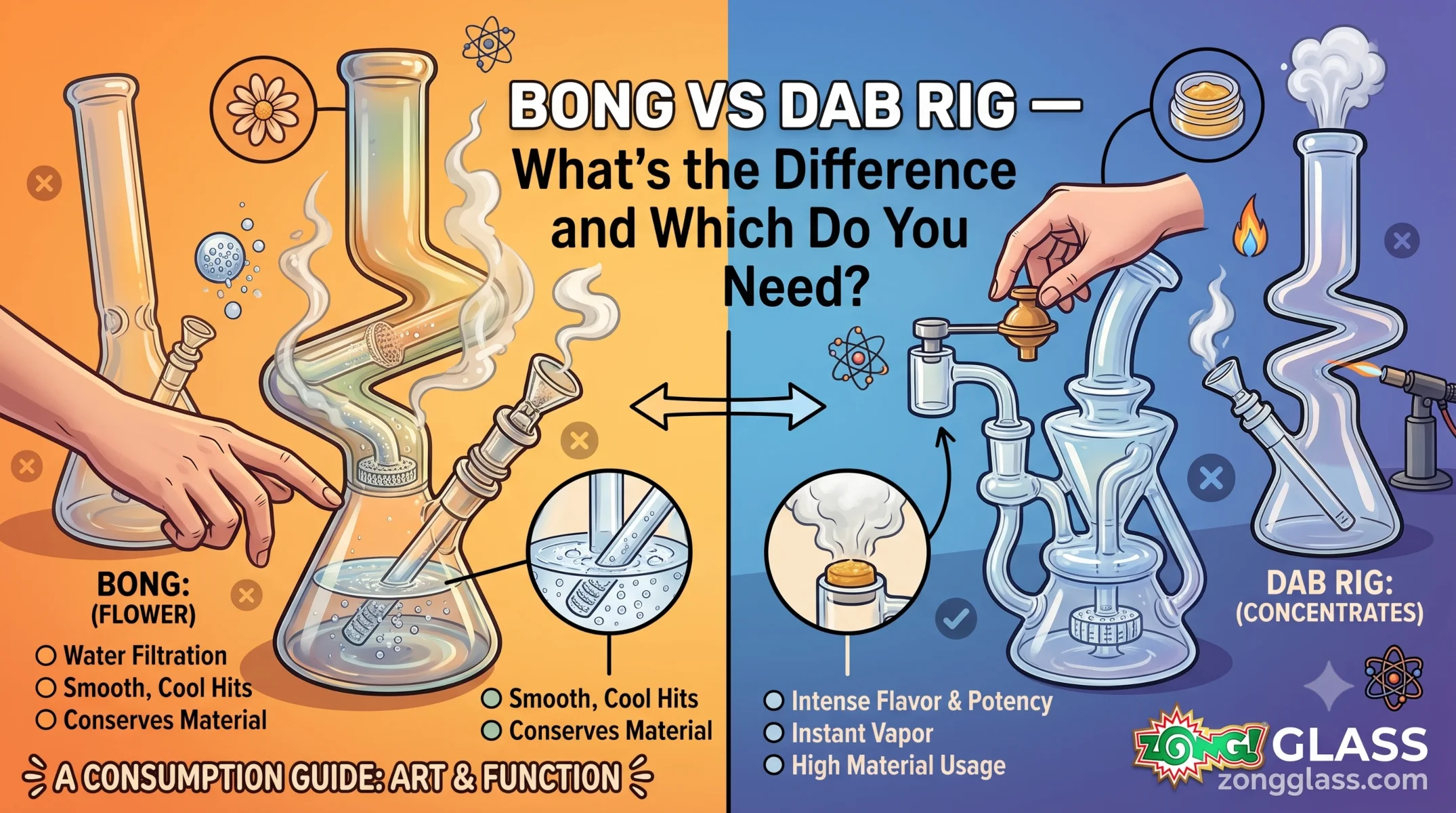
Bong vs Dab Rig — What’s the Difference and Which Do You Need?
As more smokers move between dry herb and concentrates — or use both — the question comes up constantly: do I need a separate dab rig, or can I just use my bong?
The short answer is: they’re designed for different things, they perform differently for those things, and for serious concentrate users, a dedicated rig makes a real difference. But for casual experimentation, a bong works.
Here’s the full breakdown — how each piece works, why they’re designed differently, and what the Zong Glass® oil rig offers for smokers who want American-made quality for their concentrate sessions.
How a Bong Works
A bong — or waterpipe — is designed for combustion. Dry herb is packed into a bowl, lit with a flame, and the resulting smoke travels down a downstem through water, up the chamber, and to your mouth. The water stage filters heavier particles and cools the smoke.
The key word is smoke. Combustion-produced smoke is dense, particle-heavy, and produced at relatively high temperatures. Water filtration is essential for making it inhalable comfortably, and the volume of water in a standard bong is calibrated for this — enough to cool and filter dense smoke effectively.
The standard Zong® waterpipe — from the Full Color 1 Kink Zong® to the Monster Zong® 75mm — is a combustion piece. The Z-shaped neck extends the smoke path for additional cooling, and optionally the Zubbler range adds inline percolation for maximum filtration. Every design decision is optimised for the characteristics of combustion smoke.
How a Dab Rig Works
A dab rig works on a fundamentally different principle. Instead of a bowl and lighter, you use a banger (a quartz or glass cup) heated to a specific temperature with a torch. A small amount of concentrate — wax, shatter, live resin, rosin — is placed into the heated banger, where it vaporises rather than combusts.
The resulting vapour is dramatically different from combustion smoke: thinner, lighter, richer in terpenes and active compounds, and produced at lower temperatures than combustion. This has two major implications for rig design:
Size: Vapour travels a shorter path more efficiently than smoke. A smaller chamber means less vapour lost to the glass walls before it reaches your lungs, keeping hits more concentrated and flavourful. This is why dab rigs are almost always significantly smaller than bongs — a 6–8 inch rig is typically ideal, while a standard bong of that size would be considered compact.
Water volume: Because vapour is already lighter and cooler than combustion smoke, it doesn’t need the same level of water filtration. Too much water in a dab rig over-filters the vapour, stripping terpenes and reducing flavour. The water in a rig is there for light cooling and moisture, not heavy filtration — the volumes are smaller accordingly.
Can You Use a Bong for Dabs?
Technically yes — but it’s not ideal.
You can use a dab nail or banger in a standard bong joint, and the piece will function as a rig. The experience, however, won’t match a purpose-built rig for several reasons:
Too much volume. A full-size bong chamber holds much more space than optimal for vapour. By the time vapour travels the length of a standard Zong® neck, a meaningful amount of terpene-rich vapour has condensed onto the glass walls rather than reaching your lungs. The hit arrives lighter and less flavourful than the same concentrate in a purpose-built rig.
Too much water. The water volume calibrated for combustion smoke over-filters concentrate vapour, stripping the delicate aromatic compounds that make quality concentrates worth the investment.
Temperature management. Dabs require specific temperature windows to vaporise concentrate without burning it. A bong’s different geometry makes reading and maintaining that temperature window more difficult than in a small, appropriately-sized rig.
For occasional experimentation — trying dabs for the first time, or using concentrates infrequently — a bong with a banger is fine. For regular concentrate users who want the full quality of what they’re smoking, a dedicated rig is the right tool.
The Zong® Oil Rig
Zong Glass® makes a dedicated oil rig — hand-blown in Phoenix from the same German Schott borosilicate glass as the waterpipe range, designed specifically for concentrate use.
The Zong® Oil Rig is compact in the way a concentrate piece needs to be — smaller chamber, less water volume, optimised for the lighter, more aromatic vapour that concentrates produce. Every order includes a free quartz banger, ready for your first session out of the box.
The construction is the same standard as everything else Zong® produces: hand-blown, made to order, Schott borosilicate, no mass production. The same care that goes into a six-kink waterpipe goes into every oil rig.
For concentrate users who want Zong® quality in a concentrate-specific piece — rather than adapting a waterpipe — this is the piece.
Dab Rig Temperature — Why It Matters
Getting the temperature right on a dab rig is the single most important variable in concentrate quality. The common temperature ranges:
Low temp (315–450°F / 157–232°C): Maximum terpene preservation, richest flavour, lighter vapour. Some concentrates may not fully vaporise at the low end of this range.
Mid temp (450–600°F / 232–315°C): The sweet spot for most concentrates and most users. Full vaporisation, good flavour retention, satisfying vapour density.
High temp (600°F+ / 315°C+): Dense, immediate vapour. Flavour is reduced. Not recommended for quality concentrates where the terpene profile is the point.
Standard torches heat a quartz banger to around 800–900°F in 20–30 seconds. The banger then needs to cool before the concentrate is applied — typically 30–60 seconds depending on banger thickness and ambient temperature. This is the “wait time” approach. Alternatively, carb caps are used to trap heat and vaporise at lower temperatures with consistent results.
These temperature considerations are part of why bong design and rig design differ so significantly — a rig is built around the specific thermal characteristics of vaporisation, not combustion.
Bong vs Dab Rig — The Full Comparison
| Bong / Waterpipe | Dab Rig | |
|---|---|---|
| Used for | Dry herb (combustion) | Concentrates (vaporisation) |
| Heat source | Standard lighter or torch | Butane torch |
| Chamber size | Larger | Smaller |
| Water volume | Higher | Lower |
| Filtration | Heavy | Light |
| Flavour preservation | Moderate | High (at correct temp) |
| Setup complexity | Simple | Moderate (temperature management) |
| Ideal piece size | Medium–large | Compact (6–10 inches) |
| Zong® option | Full Zong® waterpipe range | Zong® Oil Rig |
Which Do You Need?
If you primarily smoke dry herb: A Zong® waterpipe is exactly what you need. Start with the Full Color 1 Kink Zong® for an accessible first piece, or the 9mm Thick Zong® for maximum durability. The Zubbler range adds percolation for smoother hits.
If you primarily use concentrates: The Zong® Oil Rig is the right piece — compact, properly sized for vapour, with a free quartz banger included and the same Schott borosilicate construction as the waterpipe range.
If you use both regularly: Own both. A Zong® waterpipe for herb sessions, the Zong® oil rig for concentrates. Both are made to order in Phoenix, both are Schott glass, and having the right piece for each use case makes both experiences meaningfully better.
If you’re experimenting occasionally: A bong with a compatible banger is a practical starting point. Once concentrates become a regular part of your sessions, that’s the time to invest in a dedicated rig.
Shop by use: Full Color 1 Kink Zong® Waterpipe | Fat Series 50mm Waterpipe | 9mm Thick Zong® | Zubbler 50mm with Inline Perc | Zong® Oil Rig | Grunge Off Glass Cleaner | Browse all Zong® pieces