

How Percolators Affect Your Bong Hit — And Which Type Is Right for You
You’ve seen the term everywhere — percolator bongs, perc bongs, inline percs, tree percs, honeycomb percs. Every description promises smoother hits, better filtration, cooler smoke. But what’s actually happening inside the glass? And does adding a percolator to your setup actually make a meaningful difference, or is it mostly marketing?
The honest answer: percolators make a real, measurable difference to your smoking experience. But the type of percolator matters almost as much as whether you have one at all — and more isn’t always better.
Here’s everything you need to know about how percolators work, what they do to your smoke, and how Zong Glass® builds percolation into its lineup.
What a Percolator Actually Does
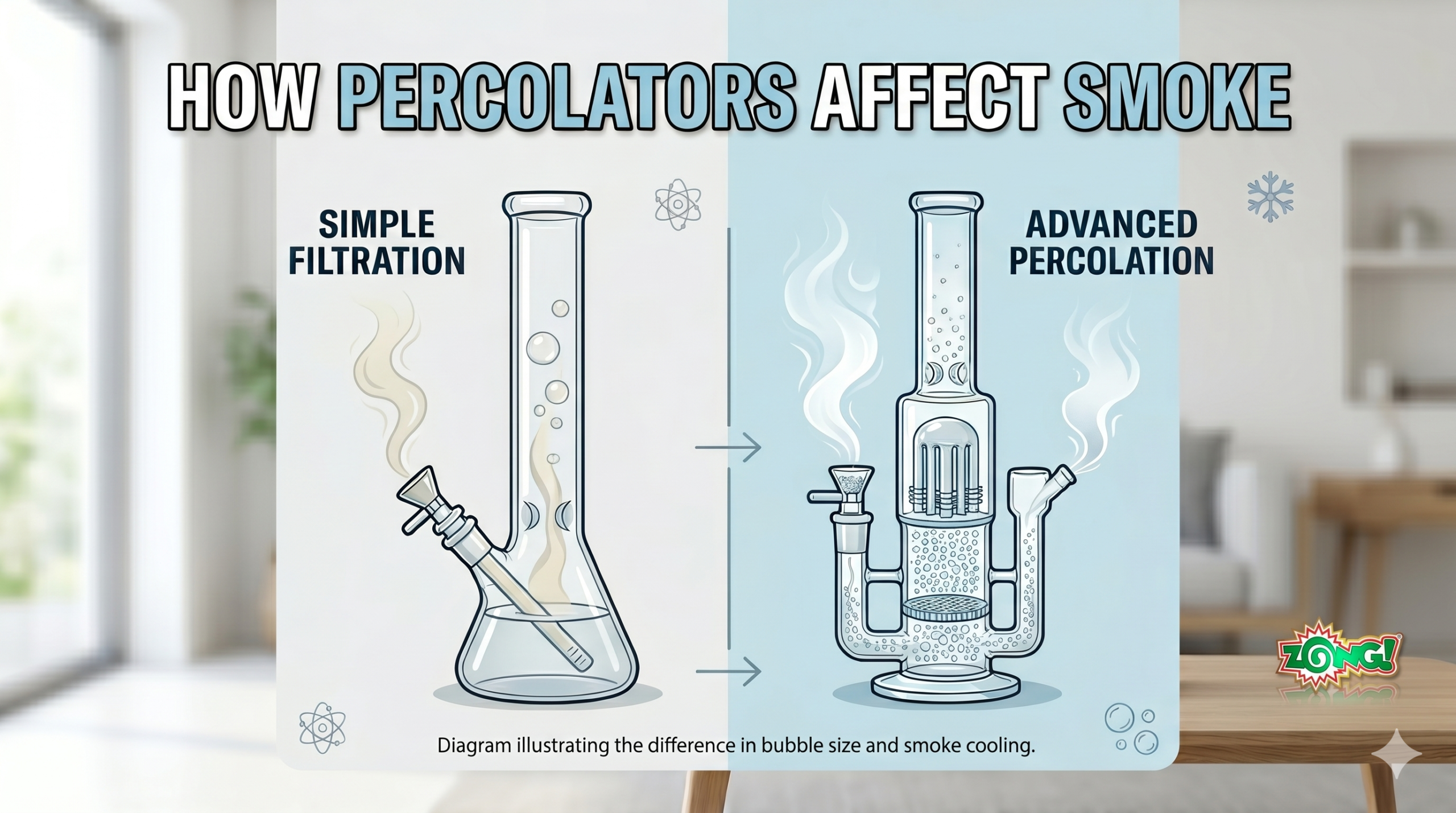
At its core, a percolator is a filtration device built into a bong that forces smoke through water via a series of small holes, slits, or channels. The physics is simple, but the effect is significant.
When smoke travels through a single large chamber of water — as it does in a basic bong with just a downstem — it passes through as one or a few large bubbles. Those large bubbles have a relatively small surface area in contact with the water. The water cools the outer edge of the bubble, but the interior of the smoke barely touches anything.
A percolator changes this entirely. By forcing smoke through dozens or hundreds of tiny holes, it breaks that single large bubble into hundreds of tiny ones. Those tiny bubbles have exponentially more surface area in contact with the water than one large bubble of the same total volume.
More surface area means two things: more cooling and more filtration.
The cooling effect is straightforward — the smoke transfers heat to the water across a much larger contact surface, dropping in temperature significantly before it reaches your lungs. Research on water-pipe aerosols has found that finer bubble diffusion can reduce smoke particle size by up to 30%, which translates directly to a smoother, less irritating hit.
The filtration effect works alongside the cooling. As smoke passes through the water in tiny bubbles, heavier particles — ash, tar, larger combustion byproducts — are more effectively stripped out. The result is cleaner, lighter smoke reaching your lungs.
In practical terms: a percolator turns a harsh rip into something noticeably smoother. The difference isn’t subtle.
The Role of the Downstem — The First Percolator
Before getting into dedicated percolator types, it’s worth understanding that your bong already has a basic percolation stage built in: the downstem.
The downstem is the tube that connects your bowl to the water chamber. On all Zong® pieces, it’s a glass-on-glass 14mm joint — airtight, clean, and no rubber grommets. As smoke travels down the stem and enters the water, it’s broken into initial bubbles. That first diffusion stage is doing real work even before any secondary percolator gets involved.
This is why the quality of your downstem matters more than most smokers realize. A well-designed downstem with slitted or diffused ends creates better initial bubble formation than a plain open-ended tube. If you’re looking to improve filtration without upgrading your full piece, a quality replacement downstem is one of the highest-impact and most affordable changes you can make.
The Main Percolator Types — What Each One Does
Inline Percolator
An inline percolator is a horizontal tube with a series of slits or holes running along its length. Rather than sitting vertically in the water chamber, it lies flat — which means smoke is diffused in a horizontal direction, spreading across a wider area of water simultaneously.
Inline percs are known for producing a smooth, even pull with minimal drag. Because the diffusion is spread laterally, the airflow resistance is lower than many other perc types, which makes them easier to clear and more approachable for everyday use.
The Zong Glass® Zubbler line is built around the inline perc. Every Zubbler — from the compact Nano Zubbler 19mm to the Micro Zubbler 25mm, Zubbler 45mm, and the full-size Zubbler 50mm — includes a custom inline perc built directly into the piece. This adds a dedicated layer of water filtration on top of the Z-neck’s natural smoke path cooling, delivering some of the smoothest hits in the Zong® lineup.
Best for: Everyday smokers who want smooth, consistent hits without excessive drag. The Zubbler’s inline perc is accessible for beginners and satisfying for experienced smokers.
Tree Percolator
A tree percolator uses multiple vertical arms — resembling the branches of a tree — each with slits or holes at the bottom. Smoke enters from the centre and is distributed across all arms simultaneously, each one diffusing independently into the water below.
The more arms, the more diffusion points, and the smoother the hit. Tree percs with eight or more arms are among the most effective filtration systems available in glass. They produce a characteristically bubbly, satisfying pull and noticeably cool the smoke.
The tradeoff is fragility and cleaning effort. The delicate arms are the most breakable part of any tree perc, and the confined spaces between arms can accumulate resin faster than simpler designs.
Best for: Smokers who prioritize maximum smoothness and filtration over durability or easy maintenance.
Honeycomb Percolator
The honeycomb perc is a flat disc perforated with dozens of small holes in a honeycomb pattern. It sits horizontally in the bong chamber and forces all smoke through its many holes at once, creating an exceptionally even and thorough diffusion.
Honeycomb percs are beloved for producing some of the finest bubbles of any perc type — very small holes mean very small bubbles, which means maximum surface area contact per pull. They also have low drag because the holes are numerous and the disc design doesn’t create significant airflow resistance.
The main limitation is that honeycomb percs can clog more quickly than other types if cleaning is neglected, since the fine holes accumulate resin faster.
Best for: Smokers who want maximum filtration with minimal pull resistance — particularly well suited to longer sessions.
Showerhead Percolator
A showerhead perc is a cylindrical chamber with a flared, perforated base — resembling an upturned shower head. Smoke enters from above and is forced down and outward through a ring of slits or holes around the perimeter, creating a wide, even diffusion pattern.
Showerhead percs produce a full, airy pull with good cooling. They’re generally easier to clean than tree percs and more durable, while still delivering thorough filtration.
Best for: A well-rounded everyday smoker who wants good filtration with easier maintenance than a tree perc.
Matrix Percolator
The matrix perc is essentially a three-dimensional grid of holes — a cylinder covered in evenly spaced perforations on multiple planes. Smoke passes through holes on both the horizontal and vertical axis simultaneously, creating diffusion from every direction at once.
Matrix percs deliver thorough, visually impressive filtration with a characteristically frothy bubble action. They’re complex to manufacture and tend to sit at the higher end of the price range as a result.
Best for: Serious collectors and filtration enthusiasts who want the most comprehensive diffusion system available.
The Percolator vs. the Zong® Neck — Two Different Cooling Systems
Here’s a distinction worth understanding clearly: a percolator cools and filters smoke through water contact, while the Zong® Z-shaped neck cools smoke through extended smoke path length — the additional distance the smoke travels through the kinks before reaching your lips.
These are two different mechanisms, and they complement each other rather than compete.
A standard Zong® without a perc uses the kinked neck to extend the smoke path, adding natural cooling and acting as a built-in splash guard. The longer the smoke path — the more kinks — the more it cools in transit. A Full Gold 6 Kink Zong provides substantially more smoke path cooling than a Full Color 1 Kink Zong, purely through geometry.
Add a percolator to that same design, and you now have two independent cooling systems working simultaneously — the inline perc filters and cools the smoke through water contact, then the Z-neck continues to cool it in transit. This is why Zubbler users consistently describe the hits as exceptionally smooth even compared to other percolated bongs: the combination of inline perc filtration plus Z-neck smoke path extension delivers cooling that neither system achieves alone.
The Monster Zong with Perc takes this to its logical extreme — a 75mm diameter piece with a 5-kink neck, a built-in percolator, and a beaker base. It’s the most comprehensively equipped smoking experience in the Zong® lineup.
The Natural Zong (Z Nat) takes a different approach: rather than kinks in the neck, the kinks are built into the natural downstem itself, which is also fitted with an inline diffusor. It’s a unique take on percolation that integrates the diffusor and the Z-geometry at the base rather than the neck.
Does More Percolation Mean Better?
Not always. More percolation means more surface area contact, which means more cooling and filtration — but it also means more drag. Every additional hole the smoke has to pass through adds resistance to the pull. Complex multi-perc setups can require a significantly harder draw to clear, which some smokers find tiring over longer sessions.
There’s also a flavour consideration. Heavy percolation filters out more of everything — including terpenes and lighter aromatic compounds that contribute to flavour. For smokers who prioritize flavour over smoothness, a lighter percolation setup (or no perc at all, relying on the Z-neck for cooling) often delivers a more expressive hit.
The practical sweet spot for most smokers is a single inline or showerhead perc — meaningful filtration and cooling, manageable drag, and straightforward cleaning. The Zubbler lineup is designed exactly around this principle.
Do You Need a Percolator?
Not necessarily — and that’s worth being honest about.
A well-designed bong without a percolator, like the standard Zong® range, already delivers significant cooling through water filtration at the downstem and smoke path extension through the Z-neck. Many experienced smokers prefer this setup for its flavour clarity, simpler cleaning routine, and lower drag.
A percolated Zong® — particularly the Zubbler range or the Monster Zong with Perc — is the choice when maximum smoothness is the priority: for smokers with throat or lung sensitivity, for longer sessions, or for anyone who simply wants the most refined hit the Zong® platform can deliver.
If you’re not sure which direction to go, the Z-Catcher ash catcher is worth considering as an intermediate step. It adds a pre-filtration stage to any standard Zong® — catching ash and loose material before it reaches the main chamber — which meaningfully improves hit cleanliness without the drag of a full percolator system. It also significantly reduces how often you need to deep clean the main piece.
The Zong® Percolator Lineup at a Glance
For smokers who want percolation built into a Zong® piece, here’s the range:
- Nano Zubbler 19mm — smallest and most compact, inline perc, full colour and fuming options
- Micro Zubbler 25mm — compact with inline perc, desktop-friendly size
- Zubbler 45mm — Skinny Series diameter with inline perc, most affordable Zubbler
- Zubbler 50mm — Fat Series diameter with inline perc, the full Zubbler experience
- Monster Zong with Perc — 75mm diameter, 5 kinks, built-in perc — the flagship percolated piece
- The Natural Zong (Z Nat) — inline diffusor built into the natural downstem, no removeable stem, unique kink-in-stem geometry
All Zubbler pieces include a 14mm bowl and downstem and are hand-blown to order in Phoenix, Arizona using premium Schott borosilicate glass.
Shop the full percolator lineup: Zubbler 50mm | Zubbler 45mm | Micro Zubbler 25mm | Nano Zubbler 19mm | Monster Zong with Perc | Z-Catcher Ash Catcher | Browse all Zong® pieces